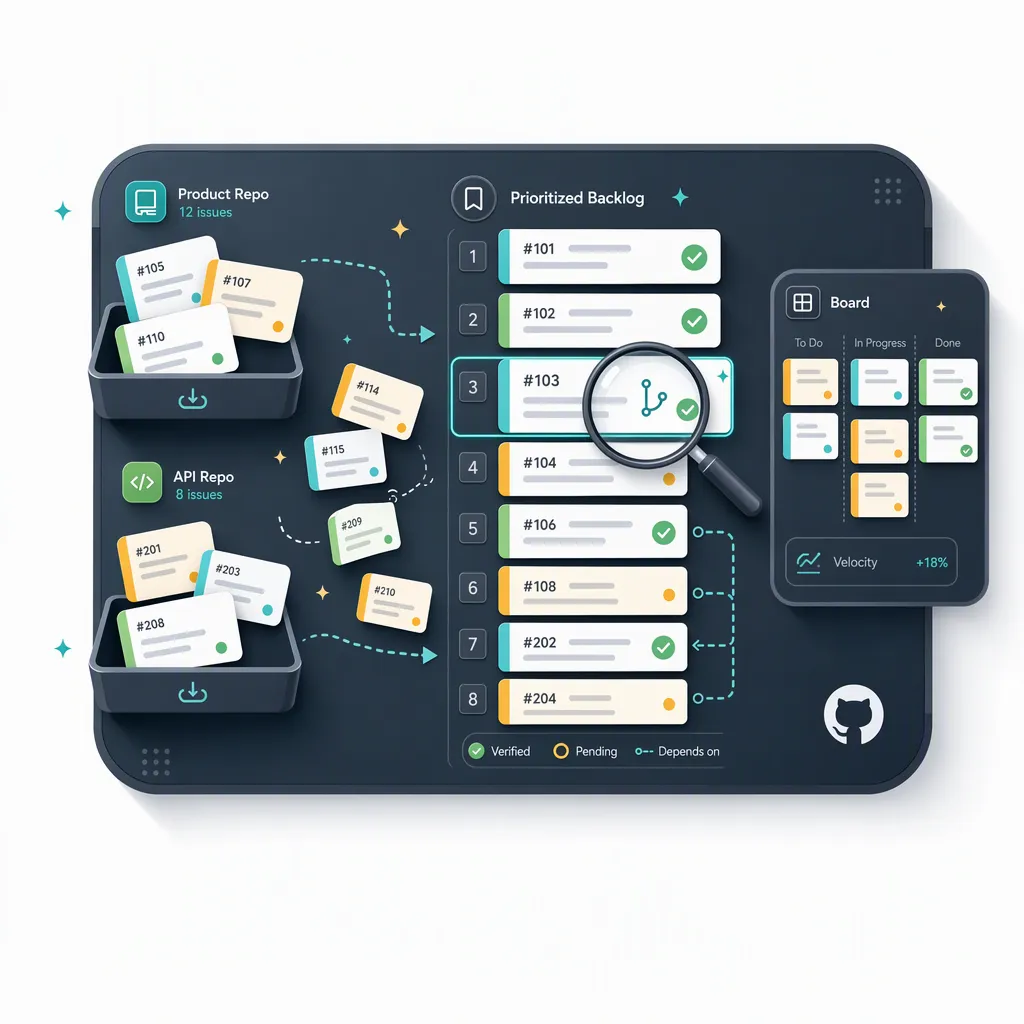
What it does
Groom GitHub backlogs across one or many issue and source repositories, with or without a GitHub Project, using scoped evidence and approved changes.
- Interviews for scope: establishes authoritative issue and code repositories, branches/tags, subdirectories, many-to-many mappings, and Project/policy boundaries without assuming the current checkout or
main. - Builds an evidence ledger: separates implementation, executed tests, installed-host qualification, live evaluation, and release approval before proposing state or completion changes.
- Organizes with or without a Project: reconciles hierarchy, dependencies, priorities, milestones, and shared Project fields while preserving existing assignees, dates, view identities, and unrelated metadata.
- Reports every disposition: summarizes changed (or proposed), preserved, unresolved, deferred, and UI-blocked items with fully qualified
owner/repo#numberreferences and evidence.
Modes
| Mode | Behavior |
|---|---|
/backlog-groom [audit] |
Read-only default: interview, inspect, build the evidence ledger, and propose changes without checkpoint writes or mutations. |
/backlog-groom apply |
Preview exact before/desired values and preconditions, obtain explicit approval, reconcile, and verify postconditions. |
/backlog-groom unattended --policy <path> |
Validate an explicitly approved bounded operator policy outside the repository, plan each issue, and apply only in-policy effects. |
Use it
/backlog-groom
/backlog-groom apply
/backlog-groom unattended --policy C:\private\backlog-policy.json